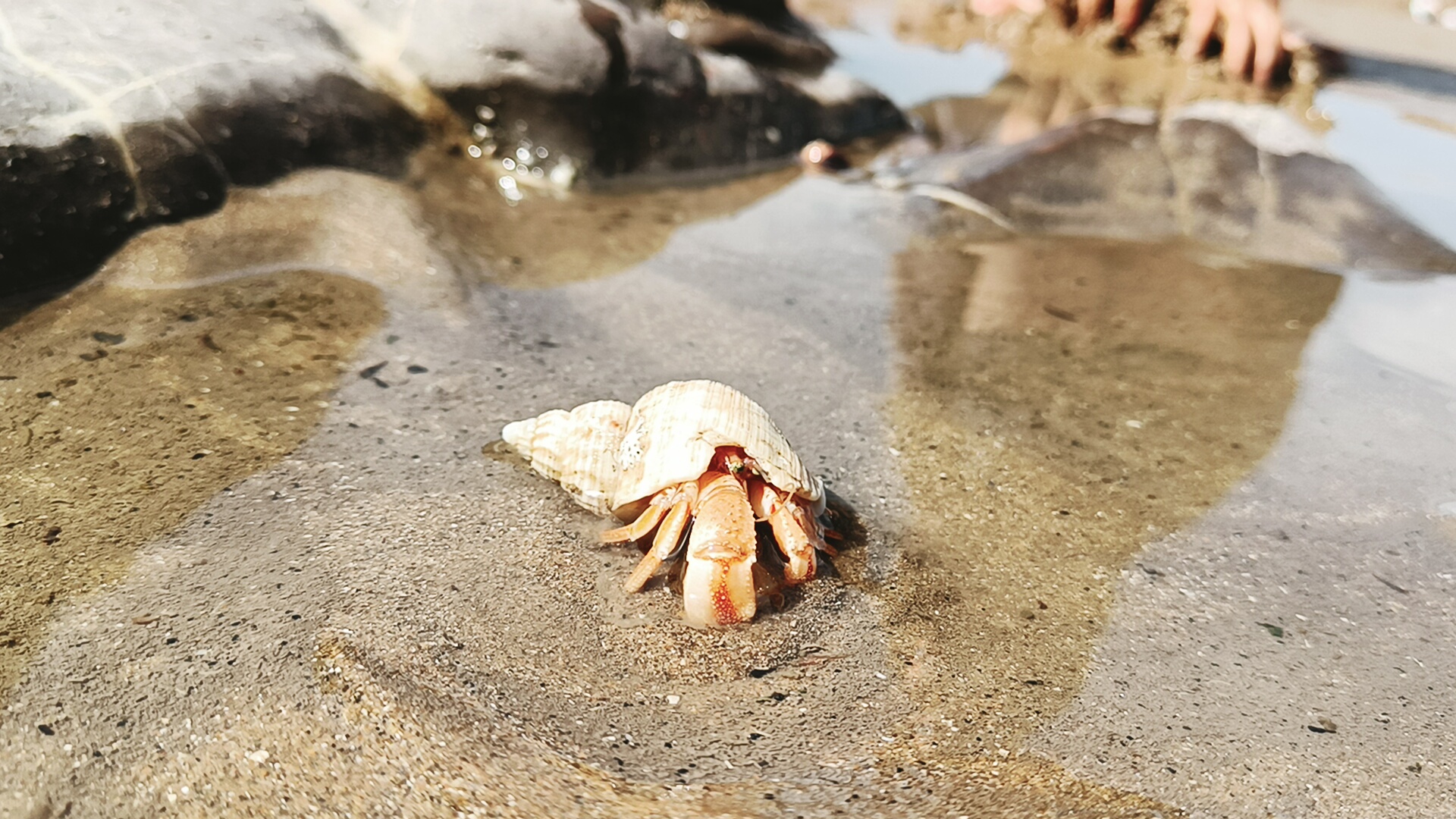
Hermit Crab Facts
Borrowed Homes
Hermit crabs don't grow their own shells — they move into empty ones left by whelks, periwinkles and other molluscs. As they grow, they upgrade to a bigger shell.
The Vacancy Chain
When a larger shell becomes available, hermit crabs line up in size order and swap simultaneously in a chain — each one moving into the next best fit. It's one of nature's most cooperative behaviours.
South Wales Rock Pools
The most common species along the South Wales coast is Pagurus bernhardus — the common hermit crab. Scoop a handful of wet sand at low tide on beaches like Southerndown or Ogmore and you're almost certain to find one.
Surprisingly Long-Lived
In the wild, hermit crabs can live up to 10 years. In captivity some species have been known to reach 30 years. Pinchy could well outlast the pizza oven.
Not Actually a Crab
Despite the name, hermit crabs are more closely related to lobsters and squat lobsters than to true crabs. Their soft, curled abdomen is what makes shell-borrowing essential for survival.
Tidal Zone Dwellers
Along the Glamorgan Heritage Coast, hermit crabs thrive in the intertidal zone — the band of rock, sand and pools that is exposed at low tide. Southerndown, Dunraven Bay and Ogmore are all hotspots.
Exceptional Smell
Hermit crabs locate food using chemoreceptors on their antennae — they can detect the smell of a rotting whelk shell from a considerable distance. Useful when you're house-hunting.
Social Creatures
Far from solitary, hermit crabs actively seek each other out. A group is called an army — and armies of them gather in Welsh rock pools every summer, especially around Southerndown beach.
The South Wales Coast
Fossils of the Glamorgan Coast
- Dunraven Bay & Southerndown — Jurassic limestone ledges packed with ammonites, bivalves and belemnites. One of the best fossil beaches in Wales.
- Nash Point — A Site of Special Scientific Interest (SSSI). The blue Liassic limestone here contains some of the finest Jurassic marine fossils in Britain, including ichthyosaur remains.
- Lavernock Point — Famous for marking the Triassic–Jurassic boundary. Fossils here date back over 200 million years.
- Ogmore-by-Sea — Ripple-marked mudstones and fossils of ancient sea creatures visible at low tide.
- Monknash & Cwm Nash — Remote cove with striking rock formations and well-preserved marine fossils in the cliff face.
Castles of the South Wales Coast
- Ogmore Castle — Norman ruin sitting right beside the River Ogmore, a short walk from Ogmore-by-Sea beach. Dates to the 12th century.
- Dunraven Castle — Now largely ruined, it overlooks Dunraven Bay and the Heritage Coast. A hauntingly beautiful spot.
- Oystermouth Castle — Perched above Swansea Bay in Mumbles. Unusual for having a chapel inside a Welsh castle.
- Kidwelly Castle — One of the best-preserved medieval castles in Wales, near Pembrey and Llanelli. Dates to 1106.
- Loughor Castle — Roman fort turned Norman castle, sitting above the Loughor estuary near Swansea.
- Coity Castle — A striking 12th-century ruin near Bridgend, one of the largest Norman castles in Glamorgan.